
CASE STUDY · SALES FUNNEL for OPULEN by Dabota
There is a particular kind of panic that happens when a product is ready before the business is ready.
The boxes are printed. The formulas are done. Somebody has already paid the manufacturer. And then somebody else asks the question nobody wants to answer: so where exactly are people going to buy this?
That was the situation we walked into with OPULEN by Dabota.
What the brand wanted
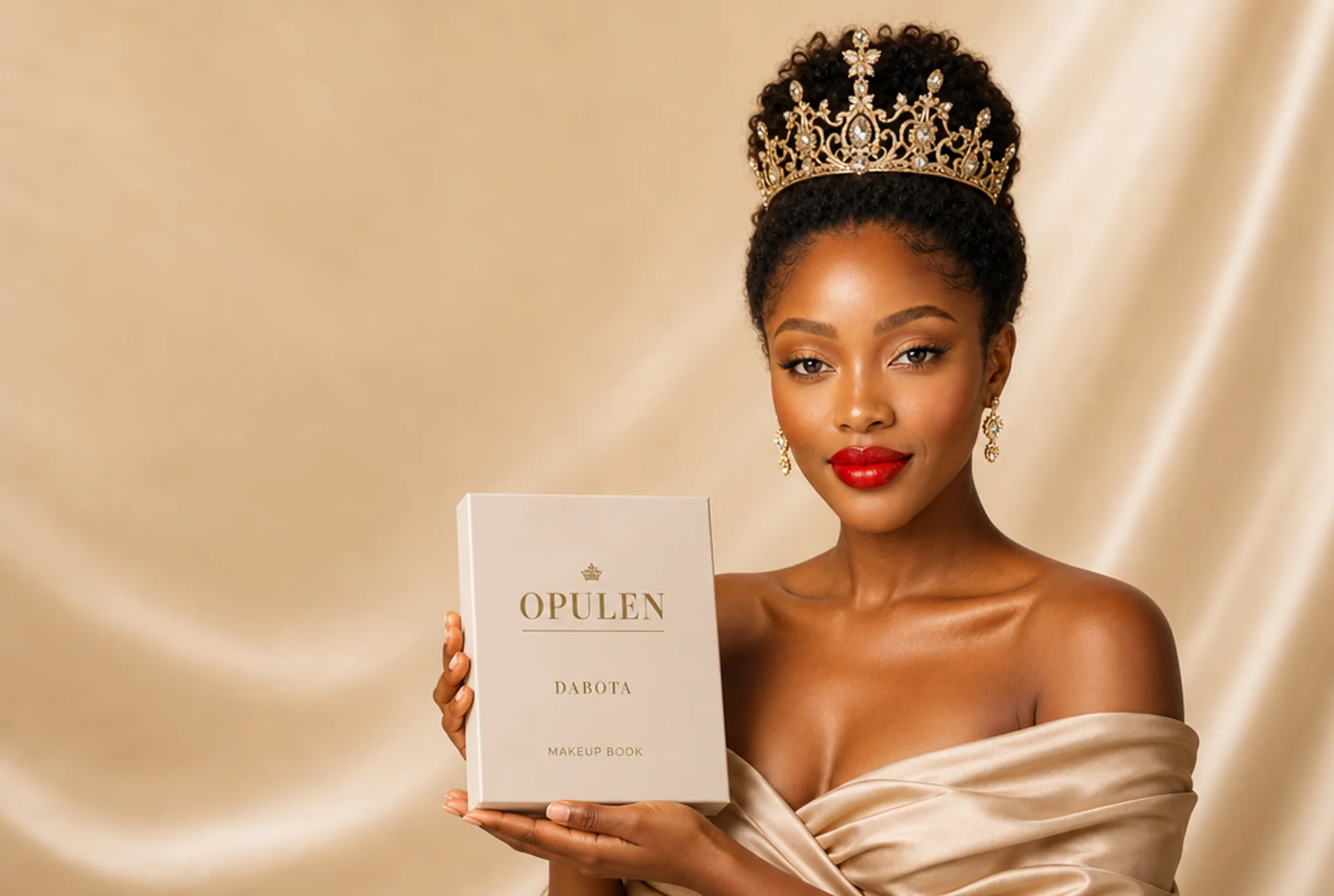
Dabota Cosmetics had made something genuinely different — not another foundation, not another palette, but an all-in-one luxury makeup book. Nine chapters. Primers, correctors, concealers, powders, blushes, bronzers, highlighters, eyeshadows, lipsticks, brow gels, liners, pencils, professional brushes. All of it inside one book, arranged in the exact order you apply it.
It is a beautiful product. It is also an expensive one. And expensive products have a particular problem online: a woman is being asked to send serious money to a brand she has never bought from, for something she cannot touch, based on photographs.
So the brief was not “build us a website.” The brief was closer to: make a stranger trust us enough to pay premium money on her first visit.
That is a different job entirely.
What we understood before we built anything
We spent the first stretch of the project not designing. Just reading.
We went through every page of the book’s interior. The shade lists. The names. The formulations. And somewhere in there, the whole strategy revealed itself in one line on the concealer page.
The shades ran from Blanc all the way to Melanin 45.
If you are a dark-skinned Nigerian woman, you already know why that matters. You know the foundation that turns grey in flash photography. You know “deep caramel” that is deep for somebody else. You know buying almost your shade, over and over, for years, and telling yourself it is fine.
That was not a feature for a bullet point. That was the emotional centre of the entire brand.
The second thing we found was the crown. Every model inside that book is wearing one. The founder’s own letter to customers opens with “Hey Queens.”
So the brand had already told us who it was. Our job was to make sure the funnel said the same thing.
What we built
A homepage that argues, not decorates.
Most beauty pages are pretty and empty. This one was built to answer, in order, the four questions a woman actually asks before spending that kind of money.
What is this? A hero that shows the box the way a jeweller shows a ring, with a scrolling pre-order line beneath it so nobody wonders whether the brand is open for business.
How do I buy it? A three-step order strip, immediately, before any storytelling. Confusion kills more sales than price does.
Who is behind this? A founder section, in Dabota’s own words and her own signature. At this price point, a customer is buying from a person, not a logo. So we showed her the person.
Will it work on me? This is where we spent the most care. A wall of crowned women — every complexion the book was made for, including the ones the beauty industry usually forgets. Beneath it, the shade range laid out as an actual swatch bar, Blanc to Melanin 45, so a woman can find her own skin on the page before she ever reaches checkout.
Then we closed with the contents. Nine chapters, laid out as chapters, so the value is not asserted — it is counted.
A product page that does the maths for her.
We did not write “luxury quality, premium ingredients.” Every brand writes that. Instead the page walks her through what is physically inside the book, chapter by chapter, and then invites her to price what she would pay assembling all of it herself, one disappointing purchase at a time.
Because the honest argument for OPULEN is not that it is cheap. It is that the makeup bag she has been building for years, purchase by purchase, cost her more.
A checkout that does not lose her at the last step.
This is where most Nigerian stores quietly bleed money, and nobody notices — because the customer never complains. She just leaves.
So we made buying as short as buying should be. No hoops between wanting the product and owning it. She pays the way Nigerians actually pay. Delivery is priced honestly by where she lives, with real timelines attached instead of vague promises, and there is an option to send her own rider if she would rather.
Then we tested the whole thing with real money before launch, because a store nobody has bought from is a store nobody has tested.
You would be surprised how many businesses skip that part.
A thank-you that behaves like a brand.
Most stores end with a grey receipt. Hers ends in her own voice — confirming the order, telling the customer when her book is coming, and giving her somewhere to write if she has a question. Then one warm invitation to follow the brand, because a customer is never more open to you than in the seconds after she has paid.
Small thing. Costs nothing. Almost nobody does it.
The part that mattered more than the design
We refused to publish anything the product could not back up.
Every shade name on the site had to match the shades that actually exist in the manufactured book. Every claim on the product page had to be traceable to the real formulation. Where our own drafts overstated something, even slightly, we cut it.
That is not us being precious. That is commercial sense. A luxury brand survives on trust, and trust is something you can only spend once. A customer who unboxes a product that does not match the website does not just return it. She posts about it.
Why 48 hours was possible
Because the thinking was done first.
Everything after strategy is execution, and execution moves fast when nobody is arguing about what the brand stands for. We were not guessing at an angle. The book told us the angle. The founder’s letter told us the voice. The shade range told us the promise.
Speed is not a shortcut. Speed is what happens when the decisions are already made.
Where it sits now
OPULEN by Dabota is live and taking pre-orders, with payment, delivery and order handling running end to end.
And because Dabota Cosmetics is a partner brand whose customer rewards we manage, the OPULEN launch also runs a cashback deal on OwoDaily — which means her customers get rewarded for buying, and our affiliate community gets rewarded for spreading it.
That is the part most agencies cannot offer. Anybody can build you a page. Very few can build you a page and bring you a network of people motivated to send buyers to it.
For affiliates
The OPULEN by Dabota cashback deal is live on OwoDaily right now.
If you have an audience of Nigerian women — beauty pages, group chats, WhatsApp statuses, TikTok, anywhere — you can earn commission on every purchase you refer, while the people you refer earn cashback for buying. Log into your OwoDaily dashboard, find the OPULEN deal, and grab your link.